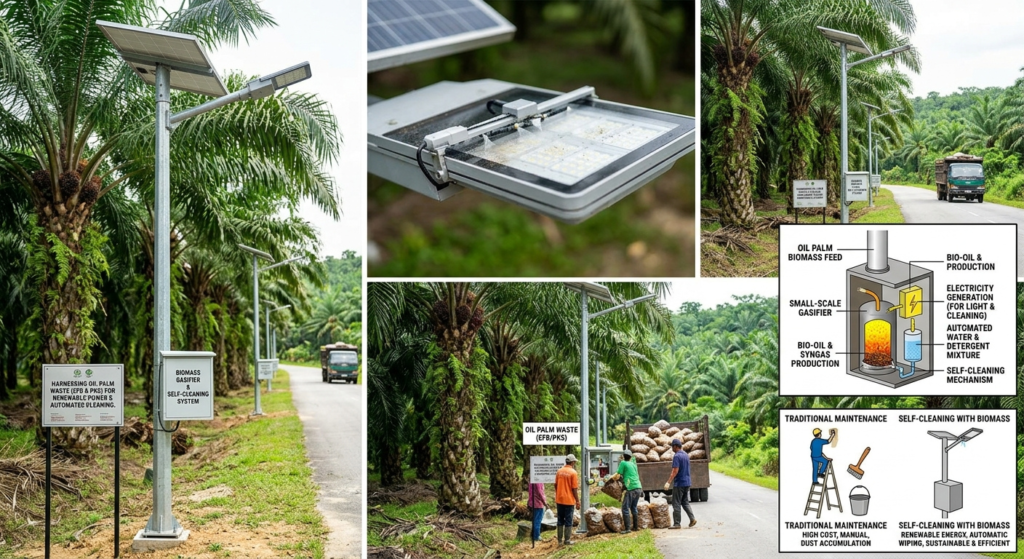

Modern cities need streetlights that are efficient, durable, affordable, and easier to maintain. At the same time, agricultural regions generate large quantities of biomass residues that can become difficult to manage when they are not properly utilized. These two challenges create an interesting opportunity: combining sustainable materials with modern outdoor lighting technology.
The idea behind self cleaning streetlight oil palm waste connects three important areas of innovation: oil palm biomass utilization, self-cleaning surface technology, and energy-efficient street lighting. It should be viewed as an emerging concept rather than a single standardized commercial technology. The exact design can vary depending on how oil palm residues are processed and which self-cleaning technology is used.
Self-cleaning surfaces are already being researched through approaches such as superhydrophobicity, superhydrophilicity, and photocatalysis. These technologies can help reduce dirt accumulation or make contaminants easier to remove through rain and light-driven reactions.
What Is Self Cleaning Streetlight Oil Palm Waste?
Self cleaning streetlight oil palm waste refers to a proposed sustainable streetlight concept in which materials derived from oil palm residues are combined with lighting components or structural materials that incorporate self-cleaning properties. The phrase does not necessarily mean that an entire streetlight is made from oil palm waste or that the complete streetlight can clean itself automatically. In practical engineering, different parts may use different materials.
Understanding Oil Palm Waste
Oil palm processing produces several types of biomass residues. Depending on the production process, these can include empty fruit bunches, fibers, shells, fronds, and trunks. Rather than sending all of this material to disposal, researchers and manufacturers can explore biomass valorization, which means turning a low-value residue into a useful product. Oil palm fibers are particularly interesting for composite-material research because natural fibers can be incorporated into selected polymer or resin systems. However, the suitability of any particular residue depends on moisture content, fiber quality, processing method, chemical treatment, and the intended application.
Common Types of Oil Palm Residues
Potentially useful residues include:
- Empty fruit bunches
- Palm fiber
- Palm kernel shells
- Palm fronds
- Palm trunks
- Other processing residues
How Self Cleaning Streetlight Oil Palm Waste Technology Could Work
The basic concept can be understood as a combination of two material systems. First, oil palm residues are collected and processed into a suitable material. Second, selected exterior surfaces are engineered to resist dirt or assist its removal. In a possible self cleaning streetlight oil palm waste design, the biomass-derived component would provide a sustainable material opportunity, while a protective surface would perform the self-cleaning function.
Self-cleaning surfaces generally rely on special wetting behavior or photocatalytic reactions. Superhydrophobic surfaces can cause water droplets to roll or slide across the surface, potentially carrying loose dirt away. Photocatalytic surfaces can use light-driven reactions to break down certain organic contaminants.
Collecting Oil Palm Residues
The first stage involves collecting suitable biomass from palm-processing or agricultural operations. The material needs to be separated from contaminants and prepared for further processing. Moisture control is especially important because natural biomass can absorb water and change its properties.
Processing the Biomass
Depending on the intended application, the residue may be dried, shredded, milled, separated, or otherwise processed. For composite applications, the processed fibers or particles may be combined with a suitable binder. The final formulation must be tested for mechanical strength, moisture resistance, dimensional stability, and outdoor durability.
Creating the Streetlight Component
The processed material could potentially be used in selected non-critical components or housings where engineering tests demonstrate that it is suitable. The electrical and structural requirements should always take priority over the sustainability objective.
Adding Self-Cleaning Properties
A protective surface treatment could then be investigated. Possible approaches include hydrophobic coatings, hydrophilic photocatalytic surfaces, or other engineered finishes. Research shows that self-cleaning performance depends not only on initial surface properties but also on durability under mechanical, chemical, UV, and environmental exposure.
Why Use Oil Palm Waste in Streetlight Technology?
The biggest attraction of self cleaning streetlight oil palm waste is the possibility of connecting agricultural waste management with sustainable infrastructure. Oil palm residues are renewable biomass resources, but renewable does not automatically mean sustainable in every application. The complete lifecycle must be considered, including collection, transportation, processing energy, manufacturing, service life, maintenance, and end-of-life disposal.
Turning Agricultural Waste Into Useful Products
Waste utilization can become more meaningful when the material is converted into a product with a practical purpose. Instead of viewing palm residues only as disposal problems, manufacturers could investigate them as feedstock for composites, panels, or other engineered materials. This approach supports the broader idea of a circular economy, where materials remain useful for longer instead of moving directly from production to disposal.
Supporting Local Material Supply Chains
In palm-producing areas, locally available biomass could potentially support regional manufacturing. That could create opportunities for collection services, preprocessing facilities, composite manufacturing, maintenance businesses, and research partnerships.
Key Benefits of Self Cleaning Streetlight Oil Palm Waste
A properly engineered self cleaning streetlight oil palm waste system could offer several potential advantages.
Reduced Surface Cleaning
Dirt, dust, soot, bird droppings, and other contaminants can accumulate on outdoor lighting equipment. A suitable self-cleaning surface may reduce the frequency of manual cleaning. Research on outdoor self-cleaning coatings identifies hydrophobic or hydrophilic behavior and photocatalytic activity as important mechanisms for assisting dirt removal.
Better Maintenance Efficiency
Streetlights are installed across large areas, making routine manual cleaning time-consuming. If a surface can maintain acceptable cleanliness for longer periods, maintenance teams may be able to concentrate on inspections, electrical repairs, and other essential work.
Agricultural Waste Utilization
The concept gives oil palm residues a potential value-added application.
This does not mean every residue should be used in streetlights. Material selection should be based on performance, safety, availability, and lifecycle economics.
Potential Environmental Advantages
A successful biomass-based material system could contribute to waste reduction and resource efficiency. Its environmental value would ultimately depend on how the material is produced and how long it remains useful.
Main Components of a Sustainable Streetlight
A modern system can combine several technologies rather than relying on one material.
| Component | Main Function | Sustainability Consideration |
| LED module | Provides illumination | High efficiency and long service life |
| Solar panel | Generates electricity | Uses renewable energy |
| Battery | Stores electrical energy | Requires responsible end-of-life management |
| Biomass composite | Potential structural or housing application | Uses agricultural residues |
| Self-cleaning surface | Helps reduce dirt accumulation | May reduce cleaning requirements |
| Controller/sensor | Controls lighting operation | Can improve energy management |
LED Lighting
LEDs are well suited to modern streetlights because they provide efficient illumination and can be controlled electronically. Combining LEDs with sustainable materials does not automatically make a lighting system environmentally superior, but efficient lighting can complement a broader sustainability strategy.
Solar Power
Solar streetlights can operate independently from conventional electricity grids when properly designed. A solar system generally includes a photovoltaic panel, battery, controller, LED fixture, and supporting structure.
Smart Controls
Motion sensors, timers, light sensors, and connected monitoring systems can help adjust lighting according to actual conditions. These technologies could make sustainable streetlights more efficient by reducing unnecessary operation.
Where Could This Technology Be Used?
Potential applications of self cleaning streetlight oil palm waste could include roads, parks, campuses, residential streets, rural communities, and agricultural regions.
Rural Roads
Palm-producing regions could be natural locations for testing biomass-based streetlight materials because the raw material may be available nearby. Solar-powered designs could also be useful where grid connections are expensive or difficult.
Public Parks
Outdoor lighting in parks is continuously exposed to dust, rain, humidity, and biological contaminants. A durable self-cleaning surface could potentially reduce routine cleaning requirements.
How Self-Cleaning Technology Works
Understanding self-cleaning technology is important before evaluating its potential use in streetlights.
Hydrophobic Surfaces
Hydrophobic surfaces repel water. When surface structure and chemistry are appropriately engineered, water droplets can move across the surface and carry loose particles with them.
Hydrophilic Surfaces
Some self-cleaning systems use highly water-attracting surfaces. Instead of forming individual droplets, water can spread across the surface and help wash away contaminants.
Challenges and Limitations
Although self cleaning streetlight oil palm waste sounds promising, significant technical challenges must be addressed before widespread adoption.
Moisture Resistance
Natural biomass can absorb moisture. Excessive moisture absorption may affect dimensional stability, strength, or durability. Material treatments and composite formulations may help, but each formulation needs testing.
UV and Weather Exposure
Continuous exposure to sunlight, rain, heat, humidity, pollution, and temperature changes can degrade materials and coatings. Research on self-cleaning surfaces emphasizes durability as a major practical consideration.
Manufacturing Costs
Processing agricultural residues into consistent engineering materials requires equipment, quality control, transportation, and skilled labor. The technology becomes commercially attractive only when the complete cost is competitive with conventional alternatives.
How to Improve Performance
Engineers developing self cleaning streetlight oil palm waste systems should focus on material preparation, surface engineering, and long-term testing.
Select Suitable Biomass
The selected residue should have consistent quality and manageable moisture content.
Improve Composite Formulation
Researchers can investigate different binders, fiber treatments, reinforcement methods, and protective layers to improve mechanical and environmental performance.
Test the Self-Cleaning Surface
Testing should measure:
- Water contact behavior
- Dirt removal
- UV resistance
- Abrasion resistance
- Chemical resistance
- Outdoor weathering
- Long-term adhesion
Self Cleaning Streetlight Oil Palm Waste vs Traditional Streetlights
Traditional streetlights generally rely on established materials such as metals, plastics, glass, and conventional coatings. A biomass-based alternative introduces a different design philosophy. Traditional systems may have well-established manufacturing and maintenance processes, while biomass-based systems could offer new opportunities for agricultural waste utilization.
Important comparison factors include:
- Initial material cost
- Manufacturing energy
- Durability
- Maintenance requirements
- Lighting efficiency
- Waste utilization
- Transportation
- Repairability
- End-of-life options
Is Self Cleaning Streetlight Oil Palm Waste Really Sustainable?
The answer depends on how the complete system is designed. Using agricultural waste is potentially beneficial, but the environmental performance can be reduced if processing requires excessive energy, transportation distances are large, the final product has a short lifespan, or the material cannot be responsibly managed at the end of its service life.
A credible sustainability assessment should therefore examine the entire lifecycle.
Lifecycle Considerations
Researchers should evaluate:
- Raw material collection
- Biomass transportation
- Processing and treatment
- Manufacturing
- Installation
- Energy consumption
- Maintenance
- Service life
- Repair and replacement
- End-of-life management
Future of Self Cleaning Streetlight Oil Palm Waste
The future of self cleaning streetlight oil palm waste technology could involve several technologies working together. Researchers may explore stronger natural-fiber composites, more durable coatings, solar-powered LED systems, smart sensors, and remote monitoring.
Advanced Biomass Composites
Future research could produce lighter, stronger, more moisture-resistant biomass composites suitable for carefully selected outdoor applications.
Improved Self-Cleaning Coatings
Researchers are investigating combinations of hydrophobicity and photocatalysis to achieve stronger cleaning performance while improving durability.
Smart Monitoring
Sensors could monitor battery condition, LED performance, temperature, energy production, and maintenance needs. This could help shift streetlight maintenance from routine schedules toward condition-based maintenance.
How to Evaluate a Sustainable Streetlight
Before adopting self cleaning streetlight oil palm waste technology, buyers and project planners should examine more than the appearance of the product.
Consider the following:
- What percentage of the material comes from verified biomass?
- What type of oil palm residue is used?
- How is the biomass processed?
- Has the material undergone outdoor durability testing?
- How long is the expected service life?
- What self-cleaning mechanism is being used?
- How well does the coating withstand abrasion?
- Is the LED system energy efficient?
- What happens to the battery and materials at end of life?
- Are relevant safety and engineering requirements satisfied?
- What is the total lifecycle cost?
Conclusion
Self cleaning streetlight oil palm waste represents an interesting intersection of agricultural waste utilization, sustainable materials, and modern outdoor lighting. Its greatest potential lies in treating oil palm residues as valuable resources while using self-cleaning surfaces to reduce dirt accumulation and maintenance demands. The concept should not be presented as a guaranteed solution or a universally proven technology. Instead, it is better understood as an area for engineering research and practical experimentation. Successful development will require high-quality biomass processing, durable composite materials, reliable lighting components, effective surface treatments, and long-term outdoor testing.
FAQs
Q1: What is self cleaning streetlight oil palm waste?
Ans: It is an emerging concept that combines oil palm-derived biomass materials with streetlight components and self-cleaning surface technologies. The goal is to explore agricultural waste utilization while reducing dirt accumulation and maintenance requirements.
Q2: How can oil palm waste be used in streetlights?
Ans: Oil palm residues may potentially be processed into composite materials for selected non-critical components, housings, panels, or structural applications. The exact use depends on material testing, safety requirements, and durability.
Q3: How does a self-cleaning streetlight surface work?
Ans: A self-cleaning surface can use hydrophobicity, hydrophilicity, photocatalysis, or combinations of these approaches. Some surfaces encourage water to carry away dirt, while photocatalytic materials can help break down certain organic contaminants under suitable light conditions.
Q4: What types of oil palm waste can be used?
Ans: Potential feedstocks include empty fruit bunches, palm fibers, palm kernel shells, fronds, and trunks. Their suitability varies according to physical properties, processing requirements, and the intended application.
Q5: What are the benefits of using oil palm waste in streetlights?
Ans: Potential benefits include agricultural waste utilization, material diversification, support for circular-economy practices, and possible reductions in manual surface cleaning when an effective self-cleaning coating is used.